Why CRI 95+ changes everything in an interior
High Ra is one consideration when selecting light. Material appearance also depends on spectrum, optics, illuminance and viewing conditions.
CRI describes average fidelity for test colours. We explain what Ra 80, 90 and 95+ can tell you and what needs checking separately on materials.
1. What CRI is
CRI, usually reported as Ra, compares the colour rendering of test samples with a defined reference illuminant of similar CCT. The reference is not always daylight. The maximum is 100; negative values are possible. Higher Ra means a smaller average difference for those samples, rather than a guarantee that every material will look natural.
Ra values of 80, 90 and 95+ help compare specific sources. They do not by themselves define a price category or the finished appearance of an interior. Check additional colour-rendering data and view material samples under the proposed light.
„CRI does not measure the amount of light. It measures how truthfully that light reveals materials."
2. What CRI 80 alone cannot tell you
Ra 80 does not identify missing wavelengths or the direction in which material colours will shift. Two sources with the same Ra can change saturation and hue differently, so the average alone is insufficient.
- Compare the hue and grain of a real wood sample.
- For stone, assess colour as well as light direction and distribution.
- For leather, check colour, gloss and texture.
- Compare clothing under the other lighting conditions in which it will be worn.
- For food, assess the colour rendering of the actual source.
For a demanding interior, compare several sources on the selected materials. Higher Ra can be a design target, but it does not replace checks of optics, glare, illuminance and other colour-rendering properties.
3. The difference between CRI 90 and CRI 95+
Ra 95+ indicates higher average fidelity for the test samples than Ra 90. The difference on an actual material also depends on spectrum and surface. Relief and shadows depend mainly on light direction and distribution; high Ra does not guarantee them.
R9 describes saturated-red rendering and is excluded from Ra, which averages samples R1–R8. It is useful supplementary information; check its value for the actual source. A premium label or price does not imply a universal R9 threshold.
„Ra and R9 inform selection; verify material appearance on samples."
4. Where CRI 95+ matters most
- Luxury residences — penthouses, villas, apartments with premium materials.
- Kitchens — faithful rendering of food and natural-stone worktops.
- Fashion Retail and showrooms — the customer must see the product's true colour.
- Galleries and private collections — true pigment rendering in artworks.
- Wellness, bathrooms and walk-in wardrobes — true skin tone for make-up and grooming.
- Hotels and Fine dining — atmosphere stands or falls with the quality of light, not its quantity.
5. The most common investor mistake
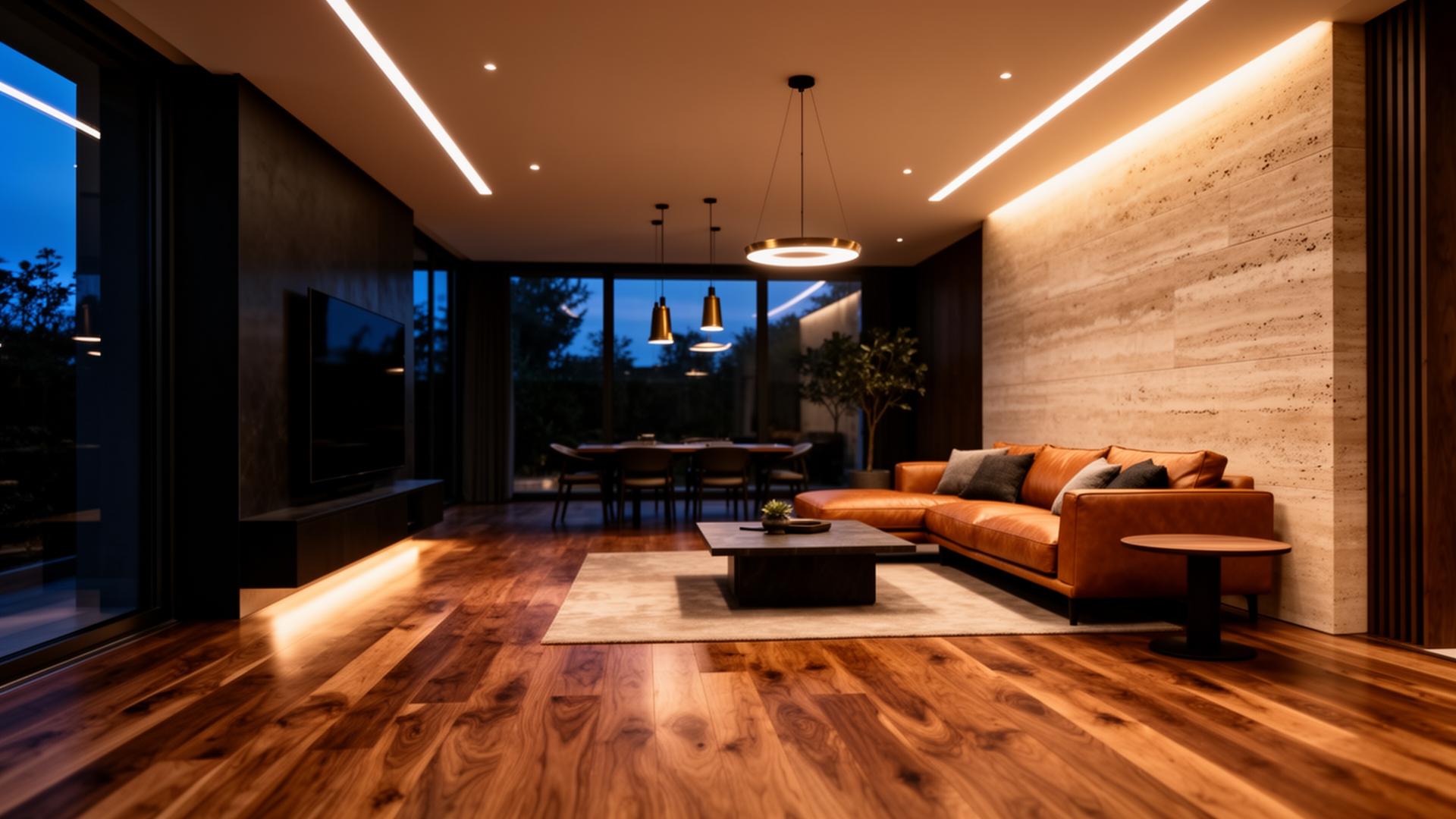
We see it again and again: a client invests tens of thousands of euros in an oak floor, stone cladding, a bespoke kitchen and an Italian leather sofa — then lights the whole space with cheap CRI 80 LED downlights bought at a DIY store.
Colour rendering can change the appearance of materials and skin. Higher CRI alone does not determine a luminaire’s price. Compare exact variants with similar output, optics, control and build quality; a universal percentage premium cannot be reliably stated.
„Materials without the right light are like a painting in the dark. They exist, but nobody sees them."
6. In closing
Ra 95+ can be a useful design target, but it is not a universal condition for a good interior. In its 2025 position statement, CIE recommends adopting the fidelity index Rf and reporting Ra and Rf together during the transition. Fidelity alone does not describe all aspects of colour quality; assess additional data and real materials.
„Good light does not draw attention to itself. It highlights the architecture, the materials and the atmosphere of the space."
Premium Light Studio
We design lighting with focus on the quality of light, not just on fixture wattage.
Discuss a project