Common mistakes
The most common mistakes in residential lighting and how to avoid them
Review layering, CCT, drivers and scenes before electrical design. This is a design checklist, rather than a project statistic.
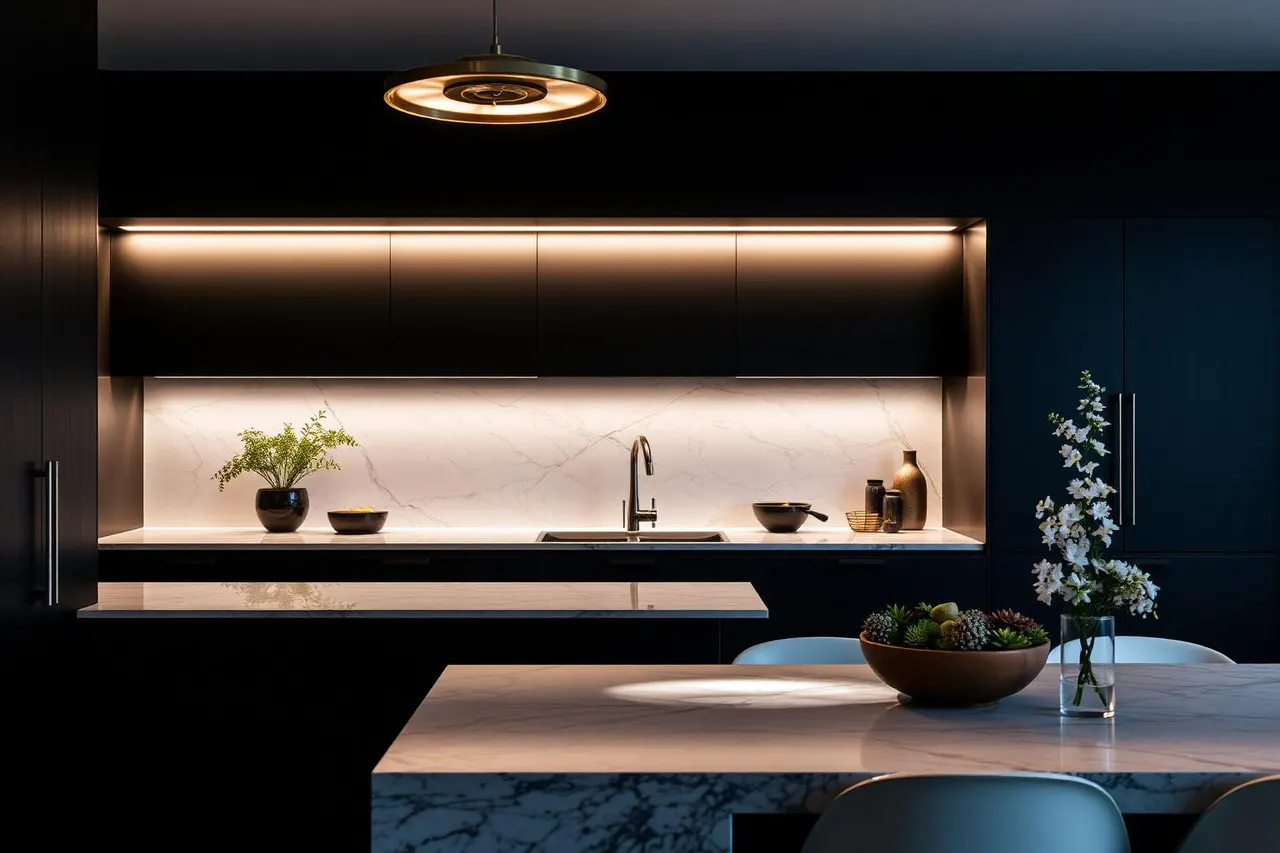
Lighting design before electrical design allows review of layers, positions, control and wiring. This list is a practical risk checklist, rather than a statistic from completed projects.
The worst call is 'one ceiling light is enough'. With no layering the room reads flat, shadows fall in the wrong places, intimacy disappears. Fix: three layers minimum.
Second is 4000–5000 K everywhere. It feels clinical. Residential should be 2700–3000 K, Hospitality 2700 K + Warm Dim. 4000 K belongs in offices or the kitchen task zone.
Ra 80 alone does not determine every material’s appearance or installation suitability. For demanding colour rendering, consider higher fidelity as a design target and check R9, available Rf/TM-30 data and samples.
An incompatible dimmer, driver and LED combination can flicker, buzz or become unstable at low levels. Select a solution using manufacturer data and a test of the complete combination; changing protocol alone does not guarantee the result.
Smart installs without programmed scenes — investment with no return. Fix: define 4–6 scenes by ritual (Morning, Work, Movie, Guests, Sleep).
Downlights directly above bed, dining or meeting table — glare and ugly shadows on faces and food. Fix: move them off-centre, use dark-light optics, or replace with a wallwasher.
Choose bathroom and wardrobe CCT for use and preferences. 4000 K alone does not mean colour distortion; check skin and textile rendering separately under the actual source.
Practical applications
Living room retrofit
Add cove ambient, reading lamp, art accent, floor lamp; dim via DALI or at least 1–10 V.
4000 K kitchen
Swap to 3000 K CRI ≥ 90 + Warm Dim on pendants; wire under-cabinet strip separately.
Bedroom with overhead downlight
Move downlight above the foot of the bed, add cove ambient (2700 K), bedside reading sconces with individual dimming, floor-level night strip.
Smart home with no scenes
Re-program KNX to four scenes (Morning, Guests, Movie, Night) on physical entry buttons.
Advantages
- Up-front planning pays back in quality of life and property value
- Layering + Warm Dim transform any room
- Dimming and scenes can reduce consumption; service-life effects depend on the assembly and operating conditions
Limitations
- Retrofitting is always pricier than planning ahead
- Some fixes need bigger renovation (coves, extra circuits)
Recommendations
- Lighting concept consultation before electrical engineering
- At least three layers in every living room
- CCT 2700–3000 K residential, 3000–4000 K task zones
- Design recommendation: consider CRI ≥ 90; assess higher targets for the actual materials and task
- Dim through a quality driver (trailing-edge, 1–10 V, DALI-2)
- Define scenes by family ritual before any Smart install
- No downlights directly above bed, dining or meeting tables
Common mistakes
- Single ceiling light with no layering
- 4000–5000 K in residential (hospital atmosphere)
- CRI 80 LED strip above the dining table
- Incompatible dimming with unstable light at low levels
- Smart install with no scenes programmed
- Downlights directly above the bed or dining table
- Cool light in bathroom and wardrobe
- No floor-level orientation for the path to the bathroom
- Mixing CCTs (3000 K + 4000 K) in the same room
- Missing eye-level layer (floor / table lamp)
In summary
Planning before electrical design helps identify mistakes early. Review layers, CCT, colour rendering, dimming compatibility, scenes and glare for the needs of the actual space.
Want a quick estimate of the luminaire count? Open the lighting calculator.
Sources
Above dining tables, kitchen islands and in living rooms, pendant lights are the most common choice. See our selection in the Pendant lights category.
Premium Light Studio
Planning a project? Get in touch.
Apply the article to your project. Use the short form to describe the space, project stage and the help you need.
Prepare the project location, approximate dimensions, preferred timing and indicative budget. You can add a link to a plan or datasheet; describe any open questions in the notes.
Prepare a project enquiryThe article topic carries into an editable note that you can expand or replace.