Retail lighting
Retail lighting: contrast, accent and colour as a selling tool
Assess contrast, merchandise colour rendering and flexible accents for the shop. The right settings depend on the merchandise and space; lighting alone does not guarantee a sale.
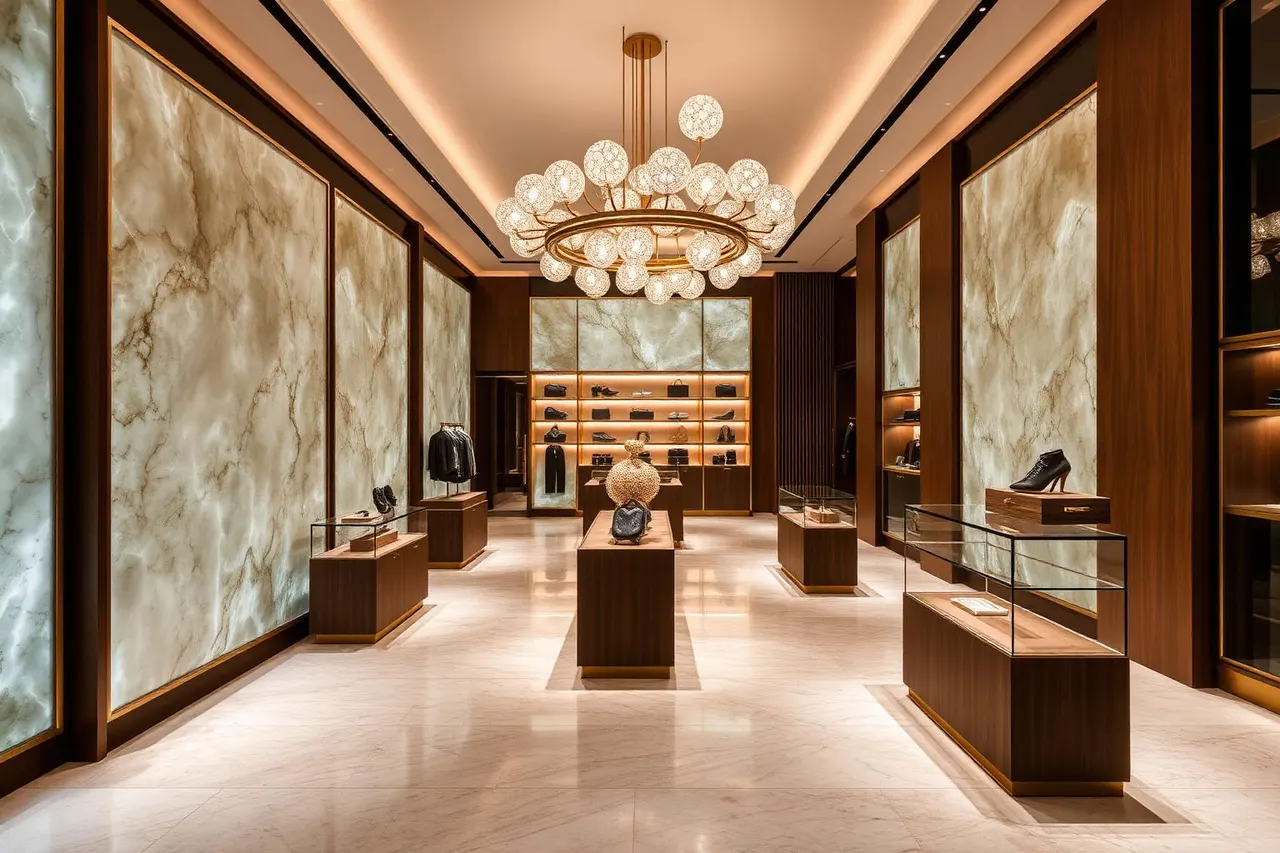
Retail lighting is not about evenly lighting a shop. It is about guiding the eye, building hierarchy and showing the product as it will look in the customer's hands. Accent-to-ambient ratio is the main tool.
Accent:ambient sets the visual hierarchy. Fashion typically 3:1 to 5:1, cosmetics 5:1, jewellery 10:1 to 15:1. A 1:1 ratio reads flat and cheap — the supermarket feel.
For fashion, cosmetics and jewellery, set colour-rendering targets for the merchandise and concept. Higher Ra or Rf can be a design choice; do not assume a universal Ra ≥ 95 and R9 ≥ 90 standard for every premium brand. Compare samples under the actual source.
CCT by category: adult fashion 3000 K, youth fashion 3500 K, cosmetics 3000–3500 K, jewellery 3500–4000 K (3000 K for gold, 4000 K for silver — or Tunable White for both). Wood and leather 2700–3000 K.
Track spots allow accent positions and aiming to change. For DALI, check compatible luminaires, adapters, track control conductors and controller; a three-phase track alone does not guarantee DALI support.
Wallwasher on the shopfront sells the invitation. Linear cove for ambient. Accent on mannequins and hero pieces via tracklight. Fitting-room mirrors get gentle vertical light (3000 K, CRI ≥ 95) — customers want a positive feeling while dressing.
Practical applications
Fashion boutique
Tracklight 70 %, ambient cove 30 %, accent:ambient 5:1, CRI ≥ 95, CCT 3000 K, wallwasher at the shopfront, vertical fitting-room sconces.
Jewellery
Highest accent:ambient (10:1 to 15:1), narrow beams (10–15°) on each piece; 3000 K for gold, 3500–4000 K for silver; cases with individual lighting CRI ≥ 95, R9 ≥ 90.
Cosmetics & Showroom
Vertical face light at the mirror, ambient 3000–3500 K, CRI ≥ 95; testing zones a touch cooler (3500 K) for accurate shades.
Food & Fine dining
Special spectra for fresh produce (often 2700 K with boosted red), 2700 K CRI 95 for wines, never cool light over plated food.
Large concept store
Zoned by category — warm welcoming entry, neutral checkout, high-contrast hero zones; DALI scenes for time of day and season.
Advantages
- Potential support for presentation and wayfinding; sales and dwell-time effects need checking in the actual shop
- Truer product colour and texture
- Easy display changes (tracklight + DALI)
- Time-of-day, sale and event scenes
Limitations
- Fittings cost more (CRI 95+, narrow optics)
- Tracklight + DALI infrastructure raises cost
- Higher energy use at very high accent ratios
Recommendations
- Accent:ambient minimum 3:1, jewellery 10:1+
- CRI ≥ 95, R9 ≥ 80 in fashion, cosmetics, jewellery
- Narrow beams (15–24°) on product, wide (36–60°) on ambient
- Jewellery display cases with their own dimmable lighting
- DALI-2 for scene flexibility and seasonal changes
- Avoid uniform 4000 K — supermarket feel
Common mistakes
- Even shop lighting with no hierarchy
- Selecting by Ra without checking the colours of the actual merchandise
- Cool light (4000 K+) over gold or wood
- No accent on the shopfront — passersby miss it
- Fluorescents in cosmetic testing zones
In summary
Contrast, colour rendering and adjustable accents are design tools. Choose CCT, fidelity criteria and control for the merchandise, tasks and concept. Ra ≥ 95, DALI or avoiding 4000 K are not universal conditions for a premium shop.
Want a quick estimate of the luminaire count? Open the lighting calculator.
Premium Light Studio
Planning a project? Get in touch.
Apply the article to your project. Use the short form to describe the space, project stage and the help you need.
Prepare the project location, approximate dimensions, preferred timing and indicative budget. You can add a link to a plan or datasheet; describe any open questions in the notes.
Prepare a project enquiryThe article topic carries into an editable note that you can expand or replace.