Wardrobe lighting
Wardrobe lighting: colour accuracy and dressing comfort
A wardrobe is where outfit decisions happen. High CRI, vertical light and integrated linear strips in the shelves are the minimum.
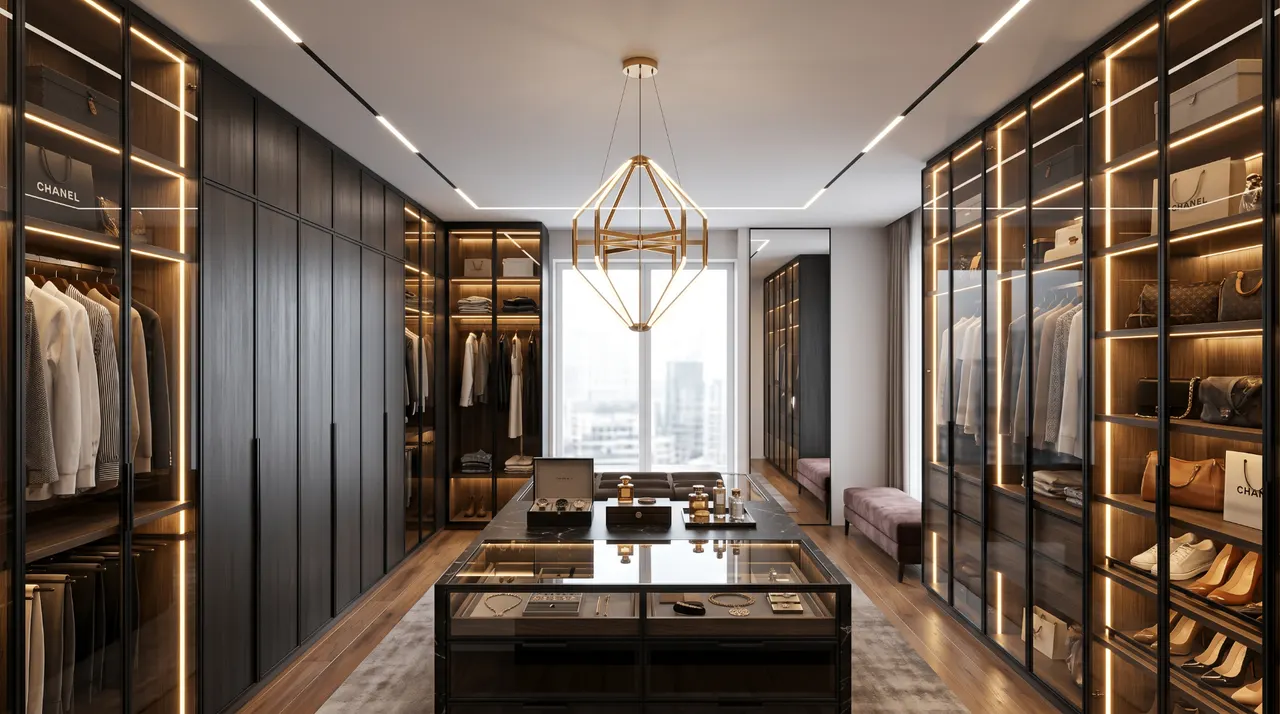
In a wardrobe, assess clothing colours and mirror lighting. A fabric changing appearance between home and work depends on the actual spectra, material and viewing conditions; Ra 80 alone does not explain it. Compare the selected source on clothing samples.
Higher fidelity can be a design target for assessing textiles. Check Ra, R9 and available Rf/TM-30 data; price or one index cannot predict discrimination between every dark shade.
3000 K can be a wardrobe design choice, rather than a universal standard. White and colour appearance also depend on spectrum and visual adaptation. Tunable White can support comparison under several white-light settings within the product’s specified range.
Vertical illumination beats horizontal. A linear LED in the side panel of a shelf throws light top-down onto hanging garments, revealing colour, texture and stains. A ceiling downlight casts shadows and clothing stays in the shade.
For walk-in wardrobes combine linear in shelves, an accent above the mirror (vertical sconces like in a bathroom) and a dim cove ambient. A sensor turns on only the active zone — energy savings plus a nice reveal.
For luminaires built into furniture, follow manufacturer mounting, cooling and clearance instructions. Distinguish permitted ambient temperature ta from temperature at the marked tc measurement point; they are not interchangeable. Check both LED module and driver.
Practical applications
Walk-in wardrobe (Penthouse)
Linear in every shelf (3000 K, CRI 95), perimeter cove ambient, vertical sconces by the mirror, motion sensor; optionally Tunable White for AM/PM.
Hotel wardrobe (Hospitality)
Intuitive for guests — auto-on by door sensor, CCT 3000 K, CRI ≥ 95, linear in shelves, accent on the hanging rail.
Built-in wardrobe
One option is a suitably enclosed linear LED strip near the upper edge, with a door sensor. Select the source for mounting conditions, colour rendering and service-life requirements; an LED, fluorescent or halogen label alone does not establish these properties.
Commercial showroom (Retail)
CRI 95+, CCT 3000–3500 K, tracklight for flexible accent on the displayed piece plus tunable linear in shelves.
Advantages
- Accurate colour and texture judgement
- Vertical light reveals stains and damage
- Motion sensor improves comfort and saves energy
- Tunable White flexes morning to evening
Limitations
- Integrated linears need joinery preparation
- CRI 95 Tunable White is pricier
- Multi-zone sensors need careful tuning
Recommendations
- Ra 90 or 95 can be a design target; assess R9 and textile samples separately, rather than treating this as a universal wardrobe standard
- CCT 3000 K, ideally Tunable White 2700–3500 K
- Linear in every shelf or at least on the top rail
- Vertical sconces at the mirror (bathroom logic)
- Door / motion sensor for auto-on
- Watch LED Tc in enclosed cabinets
Common mistakes
- Single ceiling downlight — shadows on clothes
- Selecting by technology or Ra alone without comparing textile colours
- Choosing CCT without viewing clothing under the actual source
- No shelf lighting — dark zones
- No sensor — user forgets to switch off
In summary
Assess clothing colours under the actual source and at the mirror. Higher fidelity, shelf lighting and sensors can be useful design choices; Ra ≥ 95 and 3000 K are not universal conditions for every wardrobe.
Want a quick estimate of the luminaire count? Open the lighting calculator.
Premium Light Studio
Planning a project? Get in touch.
Apply the article to your project. Use the short form to describe the space, project stage and the help you need.
Prepare the project location, approximate dimensions, preferred timing and indicative budget. You can add a link to a plan or datasheet; describe any open questions in the notes.
Prepare a project enquiryThe article topic carries into an editable note that you can expand or replace.